Kentucky Peerless Toasted Bourbon

It just seems like yesterday that people were lined around a distillery on 10th Street in Louisville to buy the first whiskey released under the name Kentucky Peerless in 100 years. It was a two-year rye that carried a $125 price tag, but no one seemed to mind that too much.

It wasn’t yesterday, however. It was a little over 7 years ago. And in the last seven years, Kentucky Peerless has released a wide variety of whiskeys: ryes and bourbons, small batches and single barrels, special finishes and secondary agings.

When they released batch 1 of their Toasted Barrel Bourbon, I loved it from the first sip. I rated it as one of my top whiskeys from the first half of 2024. Recently, Kentucky Peerless release batch 2. So, of course, a comparison is mandatory.

Batch 1:

Nose: Smokey maple syrup and naughty dark cherries

Taste: roasted nuts, dark caramel and slightly buzzed silky cream

Finish: dancing pepper on your tongue, echoes of caramel drizzled cherries and enough oak to make you reach for another pour

Batch 2:

Nose: Bit O’ Honey, delicately toasted marshmallow, cherries jubilee and Orange Julius

Taste: Orange Cream Savers, Cherry Coke, slightly over cooked peanut butter cookie, honey graham crackers and vanilla

Finish: Slight oaky, singed orange peel, honey, dark caramel and a hint of funk

As you can see (and I could taste) there are some similarities between the two batches, but that’s to be expected. Batch 2 is a drawn from a larger barrel population than Batch 1, for whatever influence that may have. Overall, Batch 2 is a bit more complex, but a bit more oaky (though certainly not near to being tannic). Batch 1 is slightly sweeter than Batch 2. Both are fantastic and worth your time, attention and whiskey budget.

Finally, congratulations to Kentucky Peerless founder, Corky Taylor, on his admission into the Kentucky Bourbon Hall of Fame!

Introducing A.J. Schreiner Spirits

It was a chilly Tuesday night in late January with a heavy mist coming down.  I’m standing in the parking lot with two other damp, shadowy figures.  One is Alan Bishop.  The other is a man I had never met before.  The other man is talking about a new spirits company he’s starting while pouring rye samples from unlabeled bottles he had in the back of his truck.  (This is a totally normal way to spend a Tuesday night and meet people, right?)  That new friend was Ken Schreiner.

A.J. Schreiner Spirits

Ken’s passion for his new project, A.J. Schreiner Spirits, was obvious and contagious, and hearing him evangelize about it made me forget about standing in a dark and cold rain.  Or maybe I didn’t mind getting a touch soaked because of how fantastic this rye from parts unknown was.  A rye that would end up being a component in the blended rye I’ll talk about later. 

A.J. Schreiner Spirits, named after Ken’s great-great grandfather will be releasing a blended rye and a gin on August 1.  These spirits are inspired by Ken’s family’s history in distilling that dates back to well before prohibition.  You can hear more about that history by listening to my conversation with Ken on this episode of Bourbon Turntable.

Ken wisely drafted Alan Bishop (head distiller at Old Homestead Distilling Co.) to be his contract distiller and blender.  Ken told Alan what he was looking for: a profile in both a rye and a gin that is reminiscent of and inspired by the spirits made by his ancestors.  Alan clearly understood the vision of A.J. Schreiner Spirits and I believe he pulled it off. 

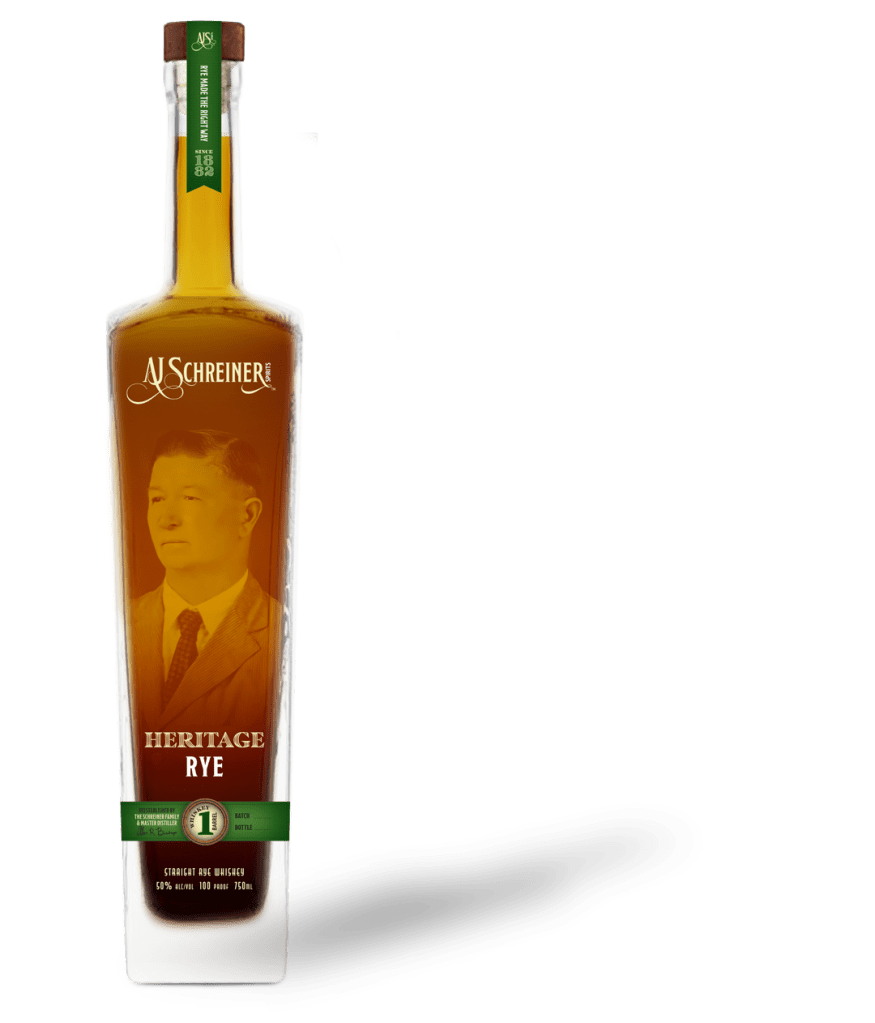
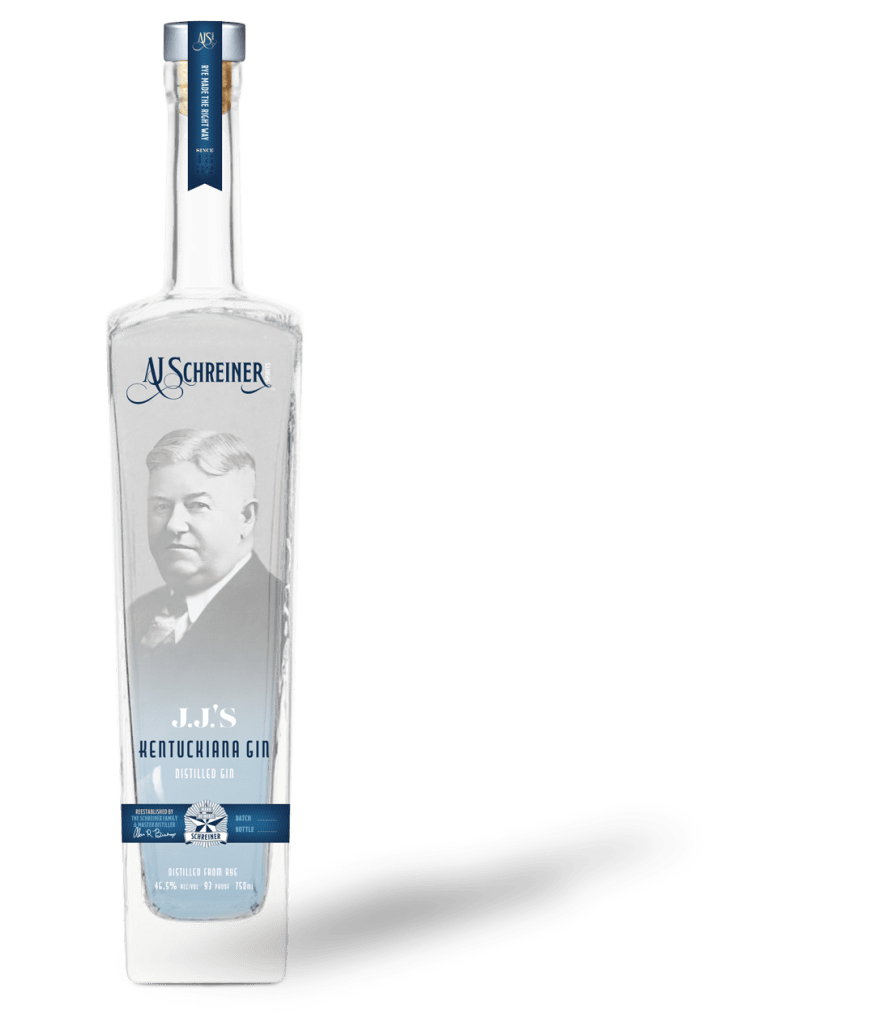
The rye, called Heritage Rye, was blended by Alan using ryes from two different distilleries.  Kentuckiana Gin was distilled by Alan and is a new take on the old Schenley gin.  The bottles feature the likenesses of A.J. Schreiner and J.J. Schreiner on the rye and the gin, respectively.

As I’m tasting these spirits again while writing this, I am pairing them with an album that I think has a gritty, speakeasy-feel to it: “Exile on Main Street” by The Rolling Stones.  I think that Charlie Watts shines on this album and the piano work by Nicky Hopkins, Ian Stewart and Billy Preston add a lot of flavor to Exile.  Rip This Joint, Shake Your Hips, Casino Boogie, Sweet Virginia, Ventilator Blues and Stop Breaking Down all capture that pre-prohibition vibe that Ken has captured in these spirits.

Tasting Notes

Heritage Rye

Facts: This is a 100-proof rye blended from two craft distilleries.

Nose: It has a grassy funkiness to it which captures that pre-prohibition feel.  Plum, fig and orange notes also rise up from my Loving Cup.

Taste: The plum and orange notes remain and toffee and dark chocolate show up to make me Happy.

Finish: You can go All Down the Line on the finish as it checks a lot of boxes: Tobacco, mint, oak, cherry and that grassy funkiness comes through again.

Kentuckiana Gin

Facts: This gin is from a rye base.  It will be 93 proof in the bottle, but my sample is at 130!

Nose: On the nose, this gin will Shine a Light on lime.  There is also some honeysuckle, orange and vanilla in there.

Taste: You can drink this Rocks Off or on the rocks.  Chilled, the lime pops through even more.  Without the ice, I get an orange cream saver note (if you remember those old Life Saver products).  If you don’t know what that is then we’ll settle calling it vanilla and orange marmalade.

Finish: I can finally Stop Breaking Down this gin by saying on the finish I find that honeysuckle reappearing.  The lime, orange and vanilla are still there and juniper pops up a bit to remind you that you are, in fact, drinking a gin.

A Vision Realized

Ken could have taken an easy route with his new spirits company. Like many other brand entrepreneurs before him, he could have bought barrels from an overused source, put it in a pretty bottle and told his family’s story that way.  He would have likely sold those bottles and been able to share his family’s history, but missed the opportunity to introduce a product of meaningful interest to the spirits community.  Thankfully, he went another way.  A more challenging, but more rewarding, way.

Ken has a vision for what he wants A.J. Schreiner Spirits to be about.  And with the skill and creativity of Alan Bishop on his team, Ken has added two spirits that will stand out in a crowded landscape.  Heritage Rye and Kentuckiana Gin are both a pleasure to drink and have an important story to tell the spirits consumer. 

Follow A.J. Schreiner spirts on Facebook and Instagram to stay in the know about news, release dates and much more.

——————————————————————————————————–

Tasting notes without the contrived Exile on Main Street references:

Heritage Rye

Nose: Funky grassiness, plum, fig and orange

Taste: Plum, orange, dark chocolate and toffee

Finish: Tobacco, mint, oak, cherry and that grassy funkiness reappears (or is it funky grassiness?).

Kentuckiana Gin

Nose: Lime, honeysuckle, orange and vanilla

Tase: Lime, orange Cream Saver (vanilla and orange marmalade

Finish: Honeysuckle, lime, orange, vanilla and the juniper sneaks in to remind you it is a gin.

America and Independence 2020

This article is not about Bourbon, but bear with me for a few minutes, please.  While I’m not writing about America’s native spirit, I believe this post is about the spirit of America.

“We hold these truths to be self-evident, that all men are created equal, that they are endowed by their Creator with certain unalienable Rights that among these are Life, Liberty and the pursuit of Happiness.”

The Founding Fathers in the Declaration of Independence at once dissolved ties with England and established a principle and a creed for the Nation they had just created.  It was a standard for America to live up to.   It was a goal that still needed to be reached even after the Revolution against England was complete. This Declaration of Independence was, and is still, a statement of hope.  

Douglass (1852)

Hope was found in The Declaration by Frederick Douglass.  In 1852 (nearly a dozen years before the Emancipation Proclamation) Douglass delivered a landmark speech “What to the Slave Is the Fourth of July?”. There are excerpts and dramatic readings of it on the internet, but they are heavily edited (you can find the full text here).  It deserves a complete read, but in summary, there are three “acts” to the speech.  The first act reminds the audience of the importance of American independence and the greatness of the founders.

“Fellow Citizens, I am not wanting in respect for the fathers of this republic. The signers of the Declaration of Independence were brave men. They were great men too — great enough to give fame to a great age. It does not often happen to a nation to raise, at one time, such a number of truly great men. The point from which I am compelled to view them is not, certainly, the most favorable; and yet I cannot contemplate their great deeds with less than admiration. They were statesmen, patriots and heroes, and for the good they did, and the principles they contended for, I will unite with you to honor their memory.

They loved their country better than their own private interests; and, though this is not the highest form of human excellence, all will concede that it is a rare virtue, and that when it is exhibited, it ought to command respect. He who will, intelligently, lay down his life for his country, is a man whom it is not in human nature to despise. Your fathers staked their lives, their fortunes, and their sacred honor, on the cause of their country. In their admiration of liberty, they lost sight of all other interests.”

In the second act, Douglass rightly blasts people, politicians and preachers of the day for allowing slavery to continue in America.  “Are the great principles of political freedom and of natural justice, embodied in that Declaration of Independence, extended to us?”, Douglass asks.  The answer, obviously and unjustly, remained “no”. Douglass went on to paint a poignant picture of the hypocrisy and sin of the continued existence of slavery in a land claiming “all men are created equal”.

In the final act of this speech, Douglass returns to the Declaration of Independence:  “Allow me to say, in conclusion, notwithstanding the dark picture I have this day presented of the state of the nation, I do not despair of this country. There are forces in operation, which must inevitably work the downfall of slavery. “The arm of the Lord is not shortened,” and the doom of slavery is certain. I, therefore, leave off where I began, with hope. While drawing encouragement from the Declaration of Independence, the great principles it contains, and the genius of American Institutions, my spirit is also cheered by the obvious tendencies of the age.”

Lincoln (1861)

In an 1861 speech, just weeks before the start of the Civil War, President Lincoln spoke of the hope derived from the Declaration: “I have often inquired of myself, what great principle or idea it was that kept this [nation] so long together. It was not the mere matter of the separation of the colonies from the mother land; but something in that Declaration giving liberty, not alone to the people of this country, but hope to the world for all future time.  It was that which gave promise that in due time the weights should be lifted from the shoulders of all men, and that all should have an equal chance. This is the sentiment embodied in that Declaration of Independence.”

Throughout his career, Lincoln’s political compass was the Declaration of Independence.  He said this at a debate in 1858: “They [the Founders who issued the Declaration] meant to set up a standard maxim for free society which should be familiar to all,—constantly looked to, constantly labored for, and even, though never perfectly attained, constantly approximated, and thereby constantly spreading and deepening its influence, and augmenting the happiness and value of life to all people, of all colors, everywhere.”

At that same debate, Lincoln went on to acknowledge “They (the Founders) did not mean to assert the obvious untruth, that all were then actually enjoying that equality, nor yet, that they were about to confer it immediately upon them. In fact they had no power to confer such a boon. They meant simply to declare the right so that the enforcement of it might follow as fast as circumstances should permit.”

King (1963)

Martin Luther King, Jr. in his legendary “I Have a Dream” speech (full text here) makes reference to the Declaration of Independence.  “When the architects of our republic wrote the magnificent words of the Constitution and the Declaration of Independence, they were signing a promissory note to which every American was to fall heir. This note was a promise that all men, yes, black men as well as white men, would be guaranteed the “unalienable Rights” of ‘Life, Liberty and the pursuit of Happiness’.”  King went on to accurately say that America had defaulted on that promissory note, “But we refuse to believe that the bank of justice is bankrupt. We refuse to believe that there are insufficient funds in the great vaults of opportunity of this nation.”

King references the Declaration as part of his hope for America: “I have a dream that one day this nation will rise up and live out the true meaning of its creed: “We hold these truths to be self-evident, that all men are created equal.”

2020

As we stand at July 4 of this notorious year, we hear calls to “cancel July 4th” and to tear down the monuments of the Founding Fathers.  The men who started this nation were not perfect.  Douglass knew it.  Lincoln knew it.  King knew it.  They, themselves, knew it.  The creed and principle they established, however, was and is still brave, brilliant and perfect:  All men are created equal, and that they are endowed by their Creator with certain unalienable rights. 

Restating Lincoln on the Declaration: “constantly looked to, constantly labored for, and even, though never perfectly attained, constantly approximated, and thereby constantly spreading and deepening its influence”.  But, still having work towards it’s attainment does not mean we abandon the principle or those who established it.  On the contrary, hold those principles up higher to guide us.  Douglass says it much better: “I have said that the Declaration of Independence is the ring-bolt to the chain of your nation’s destiny; so, indeed, I regard it. The principles contained in that instrument are saving principles. Stand by those principles, be true to them on all occasions, in all places, against all foes, and at whatever cost. From the round top of your ship of state, dark and threatening clouds may be seen. Heavy billows, like mountains in the distance, disclose to the leeward huge forms of flinty rocks! That bolt drawn, that chain broken, and all is lost. Cling to this day — cling to it, and to its principles, with the grasp of a storm-tossed mariner to a spar at midnight.”

These rights spoken of in the Declaration are not derived from government.  They are derived from God.  Government’s role is to protect those rights…not to assign them, reassign them or cancel them.  The Divine source of our rights as Americans only enhances their value.  Protect them.  Hold them dearly.  Never take them for granted.

What I have attempted to do in this post is provide a little hope in the midst of a year full of despair.  And as some are now disparaging America, her founding and her Founders, remember who you are and what you are called to as an American.  In all of our personal and national imperfections we remain the greatest nation this world has ever known.  Raise a glass to the Founders, to Douglass, to Lincoln and to King.  Raise a glass to all who strive today to bring us closer to the “never perfectly attained” creed of the Declaration.  Raise a glass to hope in this year that sorely needs it.  God bless America and all those who protect her and call her home.  Cheers!

Just Say No…

Jason is one of the funniest and most talented guys I know. He’s a musician, he’s a fantastic cook and he can effortlessly make better any gathering he’s a part of. We’re fortunate enough to have Jason as part of The Bourbon Fellowship but, aside from tailgating back in his college years, he is relatively new to Bourbon. The wonderful things about that are: (1) He thinks I know a lot about Bourbon and (2) He is willing to ask anything. That second one…that can make for some interesting discussions in our group.

A couple of weeks ago Jason asked: “Is it fair to tell someone to not use your good whiskey as a mixer?” Many of you may be hosting parties around the holidays and this very issue may be one you have to deal with. We discussed this at Bourbon Fellowship and this was the consensus opinion:

1. Just say no. If someone wants to take your William Larue Weller and mix it with Yoo-Hoo, you are well within your rights as host and owner of that bottle to nip that in the bud. The “drink what you want, how you want” rule applies to Bourbon you paid for. If someone wants a mixer, then it is quite reasonable to direct them towards a nice bottom-shelfer you’ve included on the table.

2. Know your crowd. If your invitation list is full of people who understand and respect Bourbon then you can feel a little more at ease about what to put out as your whiskey lineup for the party. Say we have a Bourbon Fellowship New Year’s party. I trust these guys to not be looking at the good Bourbon as something to liven up their Ale 8.

Like Julia Roberts and Lyle Lovett, Michter’s 10
and Dr. Pepper are great separately
but never really fit together.

3. Know your crowd (part two). If your invitation list has some who are unlearned in the ways of Bourbon (or if you just aren’t sure where they fall on the Bourbon spectrum) then leave the “good stuff” in the cabinet. That way if they want to spike the eggnog you don’t have a vein start pounding in the middle of your forehead when they reach for your Birthday Bourbon.

4. Call an audible. Say it’s your wife’s book club holiday party. The other husbands that couldn’t find an excuse to not come actually turn out to be good dudes who like Bourbon. (Let’s be realistic…one of them turns out to be a good dude who likes Bourbon). Sneak out some of the good stuff and make a discreet pour or two.

5. Don’t be “that guy”. While you have the right to set the ground rules you don’t have to be a jerk about it. If you need to re-direct someone, subtlety and discretion are useful skills. Embarrassing someone or mocking their lack of Bourbon knowledge is a d-bag move. At the end of the day, people and relationships are, of course, more important than any Bourbon

With a little planning and a generous spirit you can make the sharing of your whiskey line-up the best part of any party (holiday or otherwise). Most of us like to share our bottles and love to let others try new things and help them learn more about Bourbon. Part of learning more about Bourbon, however, is understanding that you don’t take another man’s allocated whiskey and mix it with your Dr. Pepper. No means no.

I want to wish you all a very Merry Christmas. We are all blessed more than we deserve (at least I am). I hope you have a wonderful time with family and friends as we celebrate the birth of our Savior.

Kevin Rose

In the beginning…

In the beginning God created the heavens and the earth. Now the earth was formless and empty…

Genesis (the book of the Bible not the rock band)

In the beginning?  Well, there are numerous legends, tall tales and far-fetched fables about who (in the beginning) created bourbon. Regardless of who started it, my beginnings in bourbon can only be traced back to six or seven years ago.  Before then my bourbon cabinet was “formless and empty”.  It’s only been in the past three or four years that my bourbon stash has been fruitful and multiplied. 

A year ago in February I decided the best way to celebrate my birthday was to invite a few friends over and open a newly-acquired bottle of Elijah Craig 18.  I don’t know where an EC18 ranks in your collection, but it was pretty near the top of mine and I couldn’t think of a better time to open it than with the best of company. 

This Elijah Craig 18 was outstanding. The Reverend Craig would be proud.

As we talked of legends, tall tales and far-fetched fables about each other, we sipped away about half of the delicious whiskey in that bottle. Before calling it a night, we might have sampled a bit of Blanton’s and a splash of Booker’s, too.  The guys enjoyed and appreciated the bourbon, but everyone seemed to also enjoy just being together.  Even though we didn’t have Birthday Bourbon, this birthday bourbon tasting was a great way to celebrate.

For a group of guys, however, what else would you do? Have your buddies over for birthday cake?  Most normal people like cake, but are we drinking Capri Sun and playing pin-the-tail on the donkey, too?  Probably not.  Getting together to watch a ball game is always fun, but the focus is always on the game and not the fellowship.  You could go watch a movie, but unless it’s “Die Hard 8” or “Rocky 47” or the highly-anticipated “Die Hard vs. Rocky”, then going to the movies just seems a little too date night-ish. Now you could talk me into a steakhouse and a really nice, medium-rare rib eye but, other than that, getting together to share some bourbon with friends is tough to beat.  Of course, any rib eye would likely be paired with a double pour of Kentucky Spirit anyway.

After everyone left and I was putting away glasses and bottles, I thought about how well the evening went.  It wasn’t just drinking good bourbon.  It was a few hours of laughs and conversation with friends that I just haven’t seen as often as I should. 

So, the very obvious thought occurred to me: we should do this more often.  And so, we did.

The next blog post will be about the first meeting of The Bourbon Fellowship. Many of the future posts will be about our group which will, hopefully, give you some ideas on what to do in your own group.

Kevin