It just seems like yesterday that people were lined around a distillery on 10th Street in Louisville to buy the first whiskey released under the name Kentucky Peerless in 100 years. It was a two-year rye that carried a $125 price tag, but no one seemed to mind that too much.
It wasn’t yesterday, however. It was a little over 7 years ago. And in the last seven years, Kentucky Peerless has released a wide variety of whiskeys: ryes and bourbons, small batches and single barrels, special finishes and secondary agings.
When they released batch 1 of their Toasted Barrel Bourbon, I loved it from the first sip. I rated it as one of my top whiskeys from the first half of 2024. Recently, Kentucky Peerless release batch 2. So, of course, a comparison is mandatory.
Batch 1:
Nose: Smokey maple syrup and naughty dark cherries
Taste: roasted nuts, dark caramel and slightly buzzed silky cream
Finish: dancing pepper on your tongue, echoes of caramel drizzled cherries and enough oak to make you reach for another pour
Batch 2:
Nose: Bit O’ Honey, delicately toasted marshmallow, cherries jubilee and Orange Julius
Taste: Orange Cream Savers, Cherry Coke, slightly over cooked peanut butter cookie, honey graham crackers and vanilla
Finish: Slight oaky, singed orange peel, honey, dark caramel and a hint of funk
As you can see (and I could taste) there are some similarities between the two batches, but that’s to be expected. Batch 2 is a drawn from a larger barrel population than Batch 1, for whatever influence that may have. Overall, Batch 2 is a bit more complex, but a bit more oaky (though certainly not near to being tannic). Batch 1 is slightly sweeter than Batch 2. Both are fantastic and worth your time, attention and whiskey budget.
Finally, congratulations to Kentucky Peerless founder, Corky Taylor, on his admission into the Kentucky Bourbon Hall of Fame!
It was a chilly Tuesday night in late January with a heavy mist coming down. I’m standing in the parking lot with two other damp, shadowy figures. One is Alan Bishop. The other is a man I had never met before. The other man is talking about a new spirits company he’s starting while pouring rye samples from unlabeled bottles he had in the back of his truck. (This is a totally normal way to spend a Tuesday night and meet people, right?) That new friend was Ken Schreiner.
A.J. Schreiner Spirits
Ken’s passion for his new project, A.J. Schreiner Spirits, was obvious and contagious, and hearing him evangelize about it made me forget about standing in a dark and cold rain. Or maybe I didn’t mind getting a touch soaked because of how fantastic this rye from parts unknown was. A rye that would end up being a component in the blended rye I’ll talk about later.
A.J. Schreiner Spirits, named after Ken’s great-great grandfather will be releasing a blended rye and a gin on August 1. These spirits are inspired by Ken’s family’s history in distilling that dates back to well before prohibition. You can hear more about that history by listening to my conversation with Ken on this episode of Bourbon Turntable.
Ken wisely drafted Alan Bishop (head distiller at Old Homestead Distilling Co.) to be his contract distiller and blender. Ken told Alan what he was looking for: a profile in both a rye and a gin that is reminiscent of and inspired by the spirits made by his ancestors. Alan clearly understood the vision of A.J. Schreiner Spirits and I believe he pulled it off.
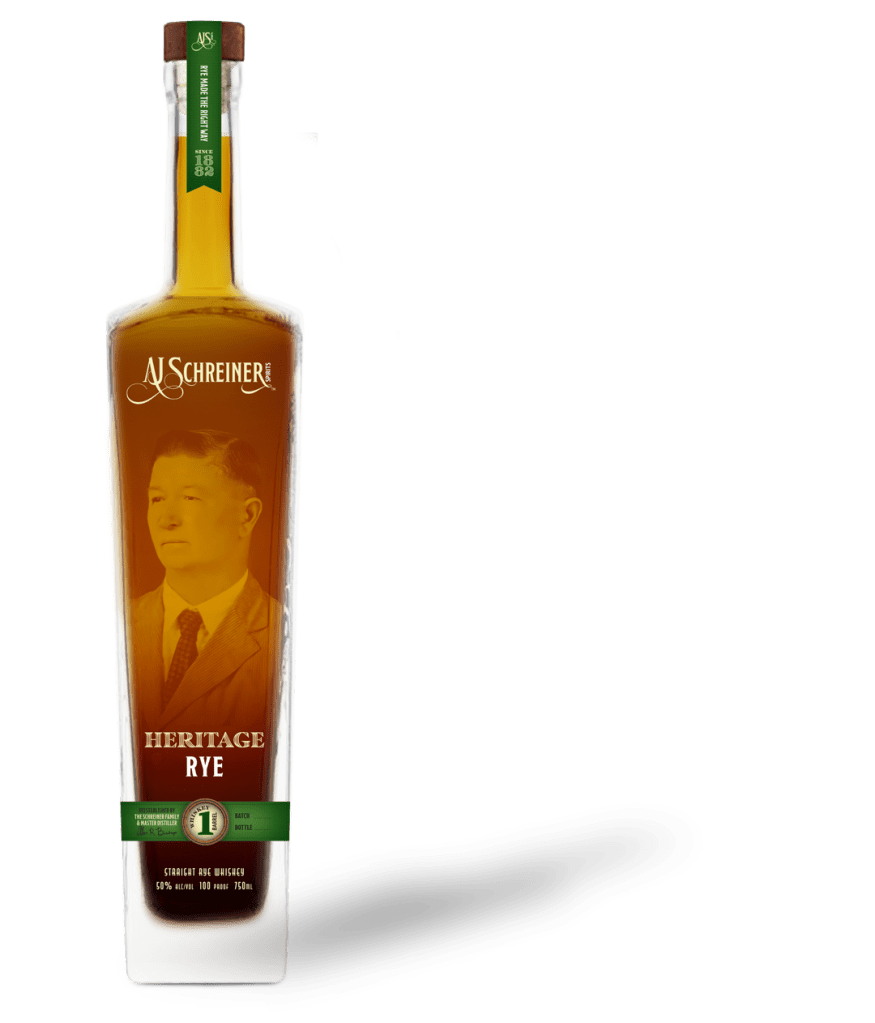
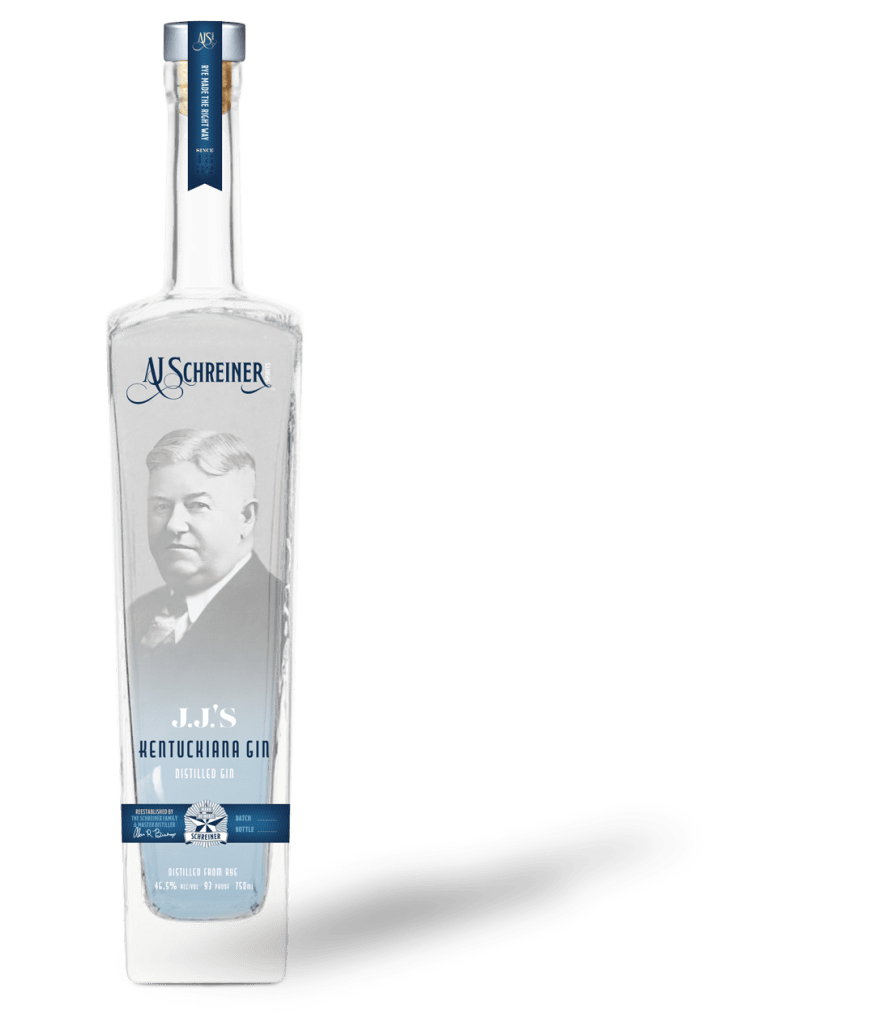
The rye, called Heritage Rye, was blended by Alan using ryes from two different distilleries. Kentuckiana Gin was distilled by Alan and is a new take on the old Schenley gin. The bottles feature the likenesses of A.J. Schreiner and J.J. Schreiner on the rye and the gin, respectively.
As I’m tasting these spirits again while writing this, I am pairing them with an album that I think has a gritty, speakeasy-feel to it: “Exile on Main Street” by The Rolling Stones. I think that Charlie Watts shines on this album and the piano work by Nicky Hopkins, Ian Stewart and Billy Preston add a lot of flavor to Exile. Rip This Joint, Shake Your Hips, Casino Boogie, Sweet Virginia, Ventilator Blues and Stop Breaking Down all capture that pre-prohibition vibe that Ken has captured in these spirits.
Tasting Notes
Heritage Rye
Facts: This is a 100-proof rye blended from two craft distilleries.
Nose: It has a grassy funkiness to it which captures that pre-prohibition feel. Plum, fig and orange notes also rise up from my Loving Cup.
Taste: The plum and orange notes remain and toffee and dark chocolate show up to make me Happy.
Finish: You can go All Down the Line on the finish as it checks a lot of boxes: Tobacco, mint, oak, cherry and that grassy funkiness comes through again.
Kentuckiana Gin
Facts: This gin is from a rye base. It will be 93 proof in the bottle, but my sample is at 130!
Nose: On the nose, this gin will Shine a Light on lime. There is also some honeysuckle, orange and vanilla in there.
Taste: You can drink this Rocks Off or on the rocks. Chilled, the lime pops through even more. Without the ice, I get an orange cream saver note (if you remember those old Life Saver products). If you don’t know what that is then we’ll settle calling it vanilla and orange marmalade.
Finish: I can finally Stop Breaking Down this gin by saying on the finish I find that honeysuckle reappearing. The lime, orange and vanilla are still there and juniper pops up a bit to remind you that you are, in fact, drinking a gin.
A Vision Realized
Ken could have taken an easy route with his new spirits company. Like many other brand entrepreneurs before him, he could have bought barrels from an overused source, put it in a pretty bottle and told his family’s story that way. He would have likely sold those bottles and been able to share his family’s history, but missed the opportunity to introduce a product of meaningful interest to the spirits community. Thankfully, he went another way. A more challenging, but more rewarding, way.
Ken has a vision for what he wants A.J. Schreiner Spirits to be about. And with the skill and creativity of Alan Bishop on his team, Ken has added two spirits that will stand out in a crowded landscape. Heritage Rye and Kentuckiana Gin are both a pleasure to drink and have an important story to tell the spirits consumer.
Follow A.J. Schreiner spirts on Facebook and Instagram to stay in the know about news, release dates and much more.
——————————————————————————————————–
Tasting notes without the contrived Exile on Main Street references:
Heritage Rye
Nose: Funky grassiness, plum, fig and orange
Taste: Plum, orange, dark chocolate and toffee
Finish: Tobacco, mint, oak, cherry and that grassy funkiness reappears (or is it funky grassiness?).
Kentuckiana Gin
Nose: Lime, honeysuckle, orange and vanilla
Tase: Lime, orange Cream Saver (vanilla and orange marmalade
Finish: Honeysuckle, lime, orange, vanilla and the juniper sneaks in to remind you it is a gin.
When Jason Brauner, owner of the iconic Bourbons Bistro restaurant in Louisville, decided to start his own whiskey brand his goal was to create a “sippable” rye. Jason was never much of a fan of rye whiskey, so he saw this as a true challenge. The acceptance of this challenge was when Buzzard’s Roost Sippin’ Whiskeys first took flight. (More on the formation of Buzzard’s Roost and their earlier releases can be found in an article I wrote for the ABV Network here).
In only a couple of years, Buzzard’s Roost had developed a reputation of creating some very unique flavor profiles out of three-year old MGP rye. That has not happened by happy accident, but by careful consideration and research that Jason has done in concert with famed cooperage, Independent Stave Company. “Through experimentation and chemical analysis of the barrels we can determine what flavor profiles we are likely to get from each barrel type”, Jason explained.
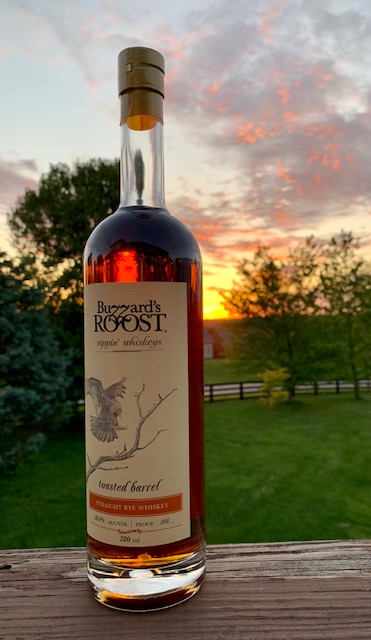
The first several releases of Buzzard’s Roost were all from barrels with a #1 char and varying degrees of toast. That all changed, however, with the introduction of the Toasted Barrel and Peated Barrel expressions.
The toasted barrel rye, bottled at 105-proof, was released in late 2020/early 2021. It is a three-year rye sourced from MGP in Lawrenceburg, Indiana with a mash bill of 95% rye and 5% malted barley. Once in the hands of Buzzard’s Roost, the whiskey is placed for six to ten weeks in a toasted barrel without char. Forgoing the char allows the rye to have more interaction with the toast of the barrel without having to filter through that layer of char.
Nose: The nose on this whiskey is fascinating. To me, it comes in waves. One moment it is citrus and cherry. The next it is mint and vanilla. Then caramel and the rye grain. Then a combination of cherry or vanilla or caramel or…you get the idea. Spend some time enjoying the aromas on this one. I love a whiskey that requires discipline to take the first sip because the nose on it is so good. It is difficult to believe all this started from a 3-year-old MGP rye.
Taste: Many of the same notes from the nose are present on the palate: rye grain, caramel, cherry and mint. Some pepper and oak are introduced here, too.
Finish: This has a nice oily finish that settles in for a spell. The pepper and oak along with lingering caramel are the most prominent notes on the finish.
We are in a whiskey world that chases trends and one of the current trends is toasted barrel releases. Many distilleries are rushing out toasted barrel products as quickly as they can. I find some of them to be very clumsy efforts that make the toasted barrel offering feel more like a gimmick than a worthwhile new expression of their whiskey. Not so here with Buzzard’s Roost. Jason and his team have brought us a toasted barrel rye with thoughtfulness and finesse. This rye has earned Buzzard’s Roost a well-deserved double gold award from the San Francisco World Spirits Competition. Unfortunately, it is rapidly disappearing from shelves now. So, grab one if you see it. Take heart, however. Jason says a new toasted barrel release will be available this fall.
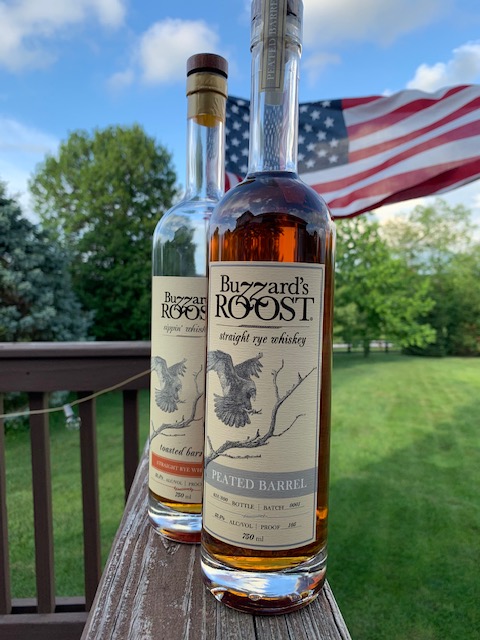
At first glance, one thing I appreciate about the peated barrel bottle is the new and improved Buzzard’s Roost label. The label includes a batch number (this is optimistically numbered batch “0001”) and a bottle count (I have bottle 618 of 800). This is a great improvement as it was impossible to tell the difference between the single barrel or very small batch bottles from 2019 or 2020. So, thank you for that label enhancement, Buzzard’s Roost.
Like previous Buzzard’s Roost whiskeys (other than barrel strength) the peated barrel is at 105-proof. Unlike previous Buzzard’s Roost whiskeys, this one uses four-year MGP rye. Another difference – obvious by the name – is the use of peat. Imported from Scotland, the peat is smoked into lightly-charred and toasted barrels by Buzzard’s Roost. The whiskey is then aged in those peated barrels for several weeks producing what Jason calls “a Scotch drinker’s rye”.
Nose: This is earthy, musty and leathery on the nose. It has some vanilla, but it is almost vanilla with an attitude in the way it mingles with the other aromas. The dill that is common to many young MGP ryes is also subtly present.
Taste: Bacon fat and smokehouse smokiness (which reminds me of the 113.4-proof barrel strength Buzzard’s Roost from last year) are delicious first impressions on the palate. There’s some butterscotch in there for something sweet. And there is, of course, the smoke from the peat. The peat influence is not obnoxious by any means (as some Scotches are to me). Rather, it is a fun complement to the smokehouse smokiness.
Finish: There is a nice blend of smokes (smokehouse and peat), along with pepper, oak and that bacon fat keeps your attention, too.
When Jason first mentioned to me Buzzard’s Roost was doing a peated barrel rye, I was both surprised and skeptical. Surprised, because I knew Jason was not a big fan of Scotch. Skeptical, because I’m not a big fan of Scotch, either!
What Buzzard’s Roost has managed to do, in my opinion, is marry an “American” version of smoke (smokehouse) with traditional Scotch smoke (peat). It is a very unique and flavorful whiskey that has cured me from any skepticism of future ambitious endeavors by Buzzard’s Roost. If Jason and Judith Hollis Jones, Buzzard’s Roost CEO, say they are going to do something, then I’ll believe they can make it happen and will anxiously wait to try the result of what they’ve envisioned.
Speaking of future ambitious endeavors…in addition to periodic barrel strength, single barrel and even private selection releases, the next big project for Buzzard’s Roost is a tobacco-smoked barrel rye. I’ll look forward to what cigar Mike Veach suggests pairing with a tobacco-smoked rye!
Buzzard’s Roost is available in Kentucky and, of all places, Massachusetts. Jason says some distributors there got a bottle and fell in love with it and have started getting it in stores. The goal for the brand is to add five more states by the end of 2021.
“We will also be looking to bring in more investors later in 2021 to help us move more quickly to the next level”, Jason said. So, if you are interested in that kind of investment opportunity, Judith and Jason are ready to talk.
If you just want to stay current on all that’s going on at Buzzard’s Roost, follow them on Facebook or sign-up for their newsletter at their website.
You can also see Jason live on My Whiskey Den on Monday, June 21 at 9:00 PM eastern time. (Click here to access the show on YouTube.) It is certain to be a great time as Patrick, Mike and Ben ask questions like a whiskey fan would and interact with their audience non-stop through the live chat. Plus, Jason, is very knowledgeable and is one of the best storytellers in the whiskey community. If you are intrigued at all about Buzzard’s Roost, make plans to tune in.



 The Bourbon Fellowship / Bourbon Turntable